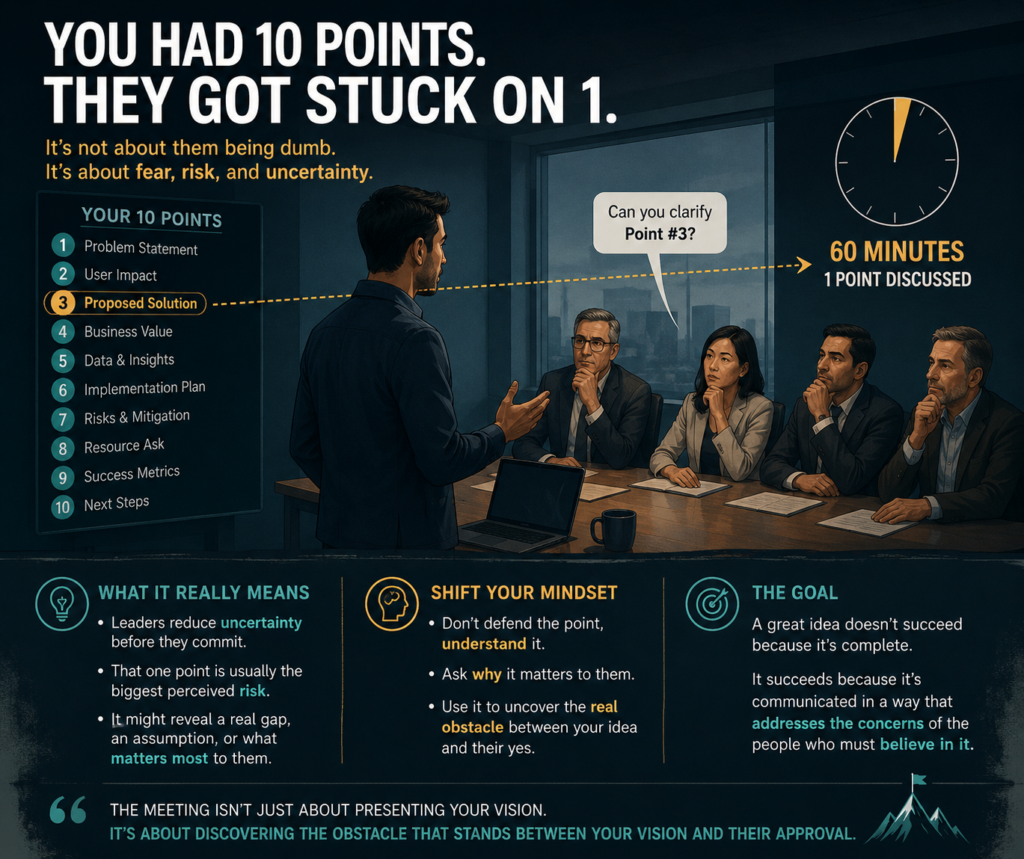
There was a time when I dreaded certain meetings.
Not because I wasn’t prepared, but because I was.I’d spend days—sometimes weeks—thinking through an idea.
I’d map out the problem, explore different approaches, talk to people, challenge my own assumptions, and refine it until I felt there wasn’t much left to question.
Then came the presentation. Ten slides. A clear story. A vision I genuinely believed in.
Five minutes into the meeting, someone from leadership would stop me.”Can we go back to slide three?” Sure. Then another question. Then another. Before I knew it, the entire hour had disappeared discussing one small part of the proposal. The remaining nine slides never even came up.
I would leave the room frustrated.” Did they even understand what I was trying to build?” For a long time, I convinced myself this was a leadership problem.”They’re too focused on details.”
“They’re missing the bigger picture.”, “They’re blocking innovation.”
It was an easy conclusion to reach because, from where I was sitting, the questioned point felt tiny compared to everything else I had prepared.
But after seeing the same pattern repeat across different leaders, different projects, and different organizations, I started wondering if the problem wasn’t them. Maybe it was the way I was interpreting the meeting. One day it finally clicked. Leadership wasn’t trying to understand every detail of my proposal. They were trying to answer a much simpler question:
“What’s the biggest reason I shouldn’t approve this?”
The question they kept asking wasn’t random.It was the point carrying the highest uncertainty.To me, it was one slide. To them, it was the risk that could make the whole initiative fail. That realization changed the way I looked at these conversations. I stopped feeling the need to defend every question. Instead, I became curious. Why are they stuck here? Sometimes that single question exposed an assumption I hadn’t noticed. Sometimes it revealed that I hadn’t explained the business impact clearly enough. Sometimes it had nothing to do with the proposal at all. It reflected a failure from a previous project, a budget concern, or a dependency I wasn’t even aware of. The discussion wasn’t about proving me wrong. It was about reducing uncertainty.
One of the biggest mistakes I used to make was trying to bring the conversation back to my agenda.”Can we move on? There are nine more slides. “Now I rarely feel that urgency. Because if an executive spends forty-five minutes on one question, they’ve already told me what’s most important to them. That’s valuable information. I’ve even started redesigning my presentations because of it. Instead of assuming people will follow the flow I created, I try to identify the questions that are most likely to stop the meeting before I even walk into the room.
Sometimes those questions become the first slide instead of the third.
Sometimes they become an appendix.
Sometimes I realize I don’t have a good answer yet—and that’s far better to discover before the meeting than during it.
Looking back, those frustrating meetings weren’t failures. They were stress tests. Not of the presentation. Of the idea itself. And honestly, I’d rather have my assumptions challenged in a conference room than discover them six months after implementation.
So now, when an hour disappears discussing a single slide, I no longer think,”They’re missing the point. “I ask myself,” What is this question trying to teach me about my idea?” More often than not, that’s where the real conversation begins.