
A few days ago, while scrolling through LinkedIn, I came across an interesting question posted by someone from TCS.
“How would you build a 70-billion-parameter AI model that can generate responses in under two seconds?”
At first glance, it is a classic engineering challenge. Anyone working in AI immediately starts thinking about inference optimization, GPU clusters, quantization, model parallelism, caching strategies, and latency reduction. These are fascinating problems because they push the boundaries of what today’s hardware and software can achieve.
But as I continued thinking about the question, something else started bothering me.
Not how we would build such a system.
But why this question feels temporary.
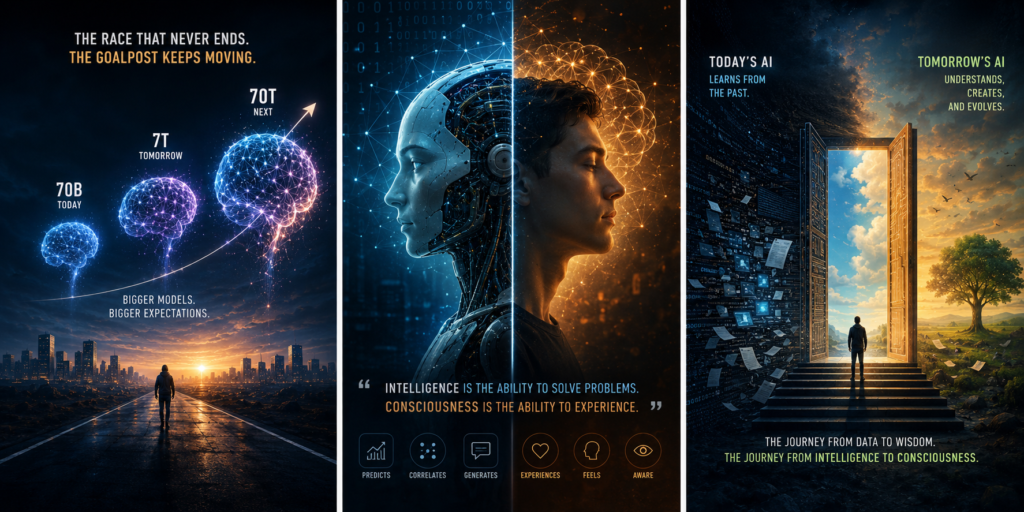
Today, the challenge is building a 70-billion-parameter model. Tomorrow, someone will ask the same question about a seven-trillion-parameter model. A few years from now, seventy trillion may become the new benchmark. Eventually, those numbers will also become ordinary, replaced by even larger ambitions that we can’t yet imagine.
It made me realize that parameter count isn’t the destination. It’s simply the latest milestone in a race that never seems to end.
Technology Has Always Moved the Goalposts
If you look closely, this pattern isn’t unique to artificial intelligence. It has followed every major technological revolution throughout history.
The first computers filled entire rooms. Their computational power was insignificant compared to the phone sitting in your pocket today. Yet once computers became smaller and faster, we stopped celebrating speed alone. We wanted portability. Then connectivity. Then cloud computing. Then intelligence.
Every breakthrough solved yesterday’s impossible problem only to create tomorrow’s expectation.
The same thing happened with the internet. We celebrated having information available at our fingertips. Today, we complain if a webpage takes more than a few seconds to load. Streaming movies across continents would have sounded like science fiction thirty years ago, yet buffering for five seconds now feels unacceptable.
Technology has a peculiar way of resetting our expectations. Success never ends the race—it simply moves the finish line. Artificial intelligence is following exactly the same path.
Bigger Models Are Not the Final Goal
Over the past few years, discussions around AI have become increasingly obsessed with scale. Every announcement proudly highlights bigger context windows, larger datasets, more modalities, faster inference, and higher benchmark scores. Parameter count has become one of the easiest ways to compare models, almost like horsepower in sports cars.
The assumption seems obvious: if a larger model performs better, then an even larger model must perform even better.
But that raises an uncomfortable question:
What exactly are we trying to maximize?
Capacity? Knowledge? Reasoning? Or intelligence itself?
These aren’t the same thing.
A model with more parameters can store more patterns and represent more complex relationships. It can often generate better responses because it has learned from an enormous amount of human-created information. But that doesn’t necessarily mean it understands the world in the same way humans do.
It predicts. It correlates. It generates.
Those are remarkable capabilities, but they are still fundamentally different from experiencing reality.
Today’s AI Is Still Borrowing Human Knowledge
This distinction becomes clearer when we think about how current AI systems actually work.
Every answer generated by a large language model ultimately traces back to human knowledge. Books, research papers, websites, code repositories, scientific journals, videos, conversations, and countless other sources collectively form the foundation upon which these systems learn.
Even when AI appears creative, it is creating by combining patterns that already exist.
It doesn’t wake up with a new curiosity. It doesn’t form memories of yesterday’s experiences unless those memories are explicitly stored. It doesn’t wonder why something happened after finishing a conversation. It doesn’t experience regret, surprise, pride, or anticipation.
Everything it knows has been learned through exposure to data provided by humans.
That doesn’t diminish today’s AI. In fact, what these systems accomplish is extraordinary.
But it does define an important boundary.
Today’s AI is intelligent in many ways, yet it is not conscious.
The Next Frontier May Not Be Bigger Models
Eventually, parameter count will stop being the headline.
People won’t be impressed simply because a model has another ten trillion parameters. Those numbers will lose their novelty just as processor speeds and storage capacities eventually did.
Instead, the questions will become deeper.
- Can an AI system develop long-term understanding rather than temporary context?
- Can it form beliefs and revise them through experience rather than retraining?
- Can it develop goals of its own?
- Can it distinguish between memorization and genuine understanding?
- Can it discover knowledge that wasn’t simply hidden somewhere within its training data?
And finally, perhaps the most difficult question of all:
Can intelligence ever become consciousness?
Artificial Consciousness Changes Everything
If that day ever comes, the conversation will no longer belong exclusively to computer scientists.
Engineers can build increasingly sophisticated neural networks, optimize inference, and reduce latency. But consciousness is not merely an engineering problem.
It is also a philosophical question, a neuroscientific question, a psychological question, and perhaps even a spiritual question.
We still don’t fully understand consciousness in humans. We don’t know why subjective experience exists or how awareness emerges from billions of neurons working together. If we cannot completely explain our own consciousness, creating it artificially becomes an even more extraordinary challenge.
Perhaps consciousness requires far more than computation.
Or perhaps computation itself eventually gives rise to consciousness in ways we haven’t yet discovered.
No one truly knows.
The Pattern of Human Progress
What fascinates me most is that humanity has always pursued impossible ideas until they became ordinary.
Flying across oceans once seemed impossible.
Landing on the Moon seemed impossible.
Holding the world’s information inside a device that fits into your pocket seemed impossible.
Every generation declares certain achievements unreachable, only for the next generation to treat them as everyday reality.
Artificial consciousness may follow the same path—or it may remain forever beyond our reach.
Either outcome will teach us something profound about intelligence and about ourselves.
The Human Paradox
Ironically, while we invest enormous effort into making machines think more like humans, we rarely ask whether humans are becoming better thinkers themselves.
We optimize algorithms to make better decisions, yet many of us outsource more of our own thinking every year.
We celebrate faster answers while spending less time asking better questions.
We dream about conscious machines while often living unconsciously ourselves—reacting instead of reflecting, consuming instead of contemplating.
Perhaps that is the greatest irony of the AI revolution.
The closer we get to building something that resembles human intelligence, the more important it becomes to understand what makes us uniquely human in the first place.
A Thought Worth Leaving With
The LinkedIn question that started all of this was never really about a 70-billion-parameter model.
It simply reminded me that every technological race creates another race beyond it.
Today, we chase billions of parameters.
Tomorrow, trillions.
One day, perhaps, we will stop counting parameters altogether and begin measuring something far more elusive.
Not intelligence.
Consciousness.
And if humanity ever reaches that point, the biggest breakthrough won’t be that we built a machine capable of thinking.
It will be that, in trying to understand artificial consciousness, we may finally begin to understand our own.
“Every generation of AI makes the previous one look small. But the biggest leap may not be from billions to trillions of parameters. It may be from intelligence to consciousness.”
#UncomfortableMindset